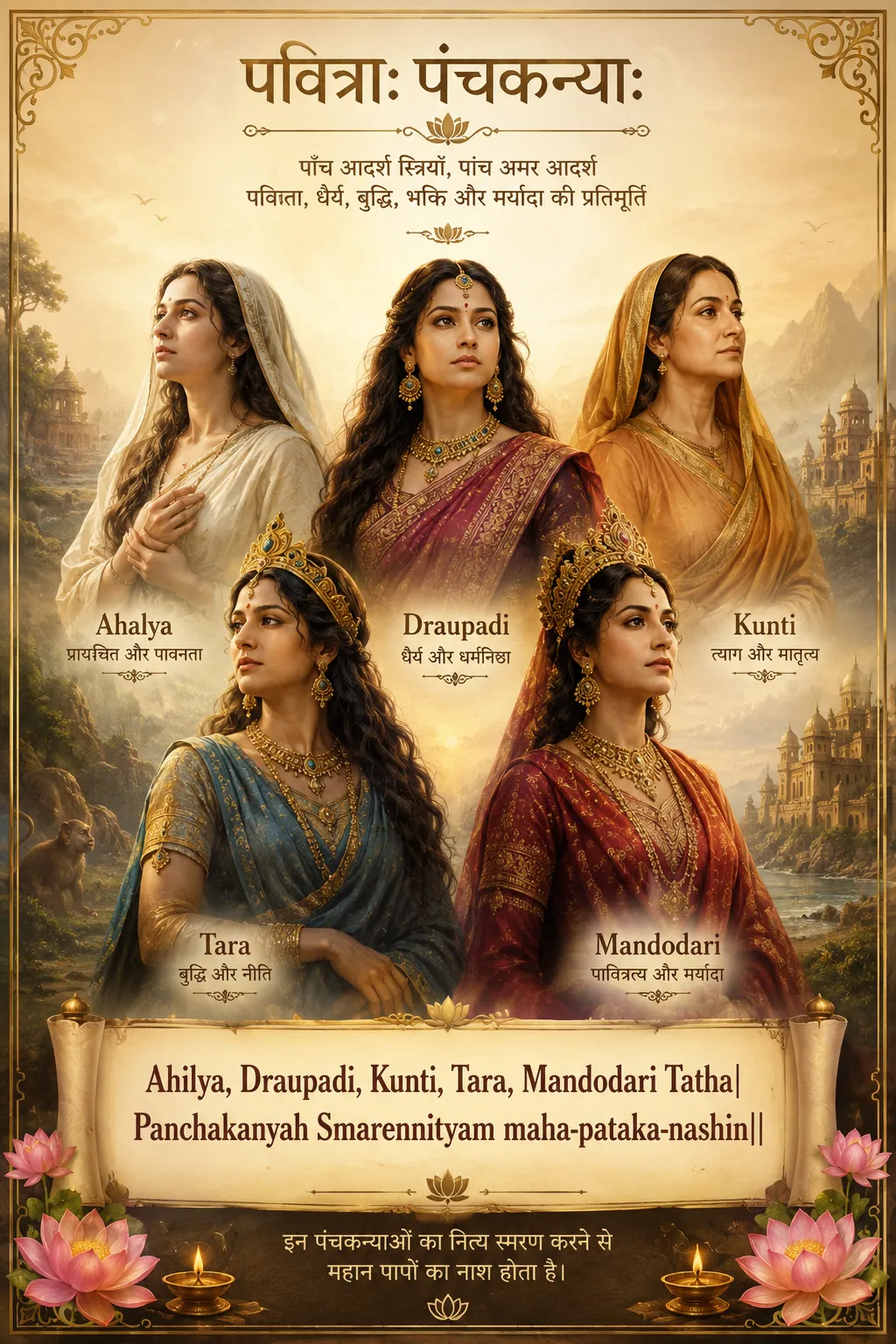
Panchakanya; the literal translation is, “Five Maidens” or “Five Daughters”. The famous Sanskrit couplet goes on explaining that one should remember the five maidens; such as Ahalya, Draupadi, Kunti, Tara and Mandodari; to get freed from greater sins!
Ahilya, Draupadi, Kunti, Tara, Mandodari Tatha|
Panchakanyah Smarennityam maha-pataka-nashin||
Who Are These Panchakanya?
As per this couplet, the five maidens are Ahalya, Draupadi, Kunti, Tara and Mandodari. Let’s know a bit about them.
Ahalya
Ahalya is the wife of sage Gautam. As per Valmiki Ramayana, once Indra disguised as sage Gautam, entered his hermitage and seduced Ahalya. Although she recognized Indra, she allowed herself to be seduced. When sage Gautam came back and saw Indra in the hermitage; he understood everything. In a fit of rage, he cursed both of them. Indra has been cursed to lose his manhood while Ahalya has been cursed to remain invisible by all and survive only on air, till Ram visits her. Long after this episode, Ram, Lakhman and sage Vishwamitra visited their hermitage. By touching her feet, Ram lifted the curse. She again united with sage Gautam.
Draupadi
Draupadi was born from yajna; so she is also called Yajnaseni. Arjuna won her hand in the swayamvar, by proving his might. But a simple misunderstanding between Kunti and Pandavas, puts her in dilemma. Upon returning home with Draupadi, the Pandavas told their mother, that they had brought back a valuable prize. Without seeing what they had brought, Kunti instructed them to share it equally among themselves. Bound by their mother’s words and the importance attached to honoring them, the brothers found themselves in a difficult situation. She ended up marrying all the five brothers, to keep the words of Kunti truthful. With the guidance of the sage Vedavyasa, a unique arrangement was established to prevent discord among the brothers. Draupadi became the wife of all five Pandavas, but she would reside with only one husband at a time according to a fixed order.
Kunti
Kunti was the adopted daughter of Kuntibhoj. Before her marriage, she got a boon from sage Durvasa, to have a child from any God she would desire. Out of curiosity, she tested the boon on Surya Bhagwan and ended up being an unmarried mother. To avoid any societal backlash, she abandoned that child. Later, she got married to Pandu, the King of Hastinapur. However, a strange curse made it impossible for her to have any child from Pandu. Again at the request of Pandu, she used her boon to get three sons from three different Gods; Dharma, Vayu and Indra. Later, she also helped Madri, to get two more sons from Ashwini Kumar with the help of this boon.
Tara
Now, this is a little confusing one. There are two ladies with the name “Tara” in Indian mythology. Tara is the wife of Vali, the vanara king. In Ramayana, she is depicted as one of the wisest queens. She advises Vali not to fight Sugreeva when he asked to fight for the second time. As per popular narrative, after the death of Vali, she got married to Sugreeva. When Lakhmana angrily walks into Kiskindhya royal hall to rebuke Sugreeva for his lazy attitude in searching for Sita; it was Tara who calmly handled the situation.
The other, Tara is the wife of Vrihaspati. She later fell in love with Chandra and eloped. The love story brings chaos. The Gods stood by Vrihaspati and Asura’s stood by Chandra; resulting in one of the greatest Dev-Asura wars of that time. After the intervention of Brahma, Tara came back to Vrihaspati, while carrying the seed of Chandra in her womb.
Madodari
Mandodari is the wife of Ravan. In many accounts, she is portrayed as one of the pious ladies. She advised Ravan not to kidnap Sita and invited bad karma. In some versions of Ramayana, she stopped Ravana from killing Sita. As per popular belief, after the death of Ravan, she married to Vivishana.
Origin & Significance
The exact origin of the Panchakanya verse is uncertain. Many scholars believe that it emerged from folk traditions and was later incorporated into the broader religious and cultural landscape. This raises an interesting question: why were these five women grouped together and celebrated in a single verse?
One thing that is obvious in all these five stories is that these ladies have more than one partner in their life. When viewed through conventional social norms, this is unacceptable; particularly in Kaliyug. However, there are many such instances in our mythology where a single lady has multiple husbands. Although, it is not common but it is not considered as a sin either! But with evolving time, the definition of morality keeps on narrowing. So, to keep a balance, some of the scholars must have come up with this couplet which made a startling point that, irrespective of these transgressions; these five remain absolutely sinless. It suggests that virtue and purity should not be judged only through social conventions. These five figures are worthy of remembrance and reverence for their virtue.