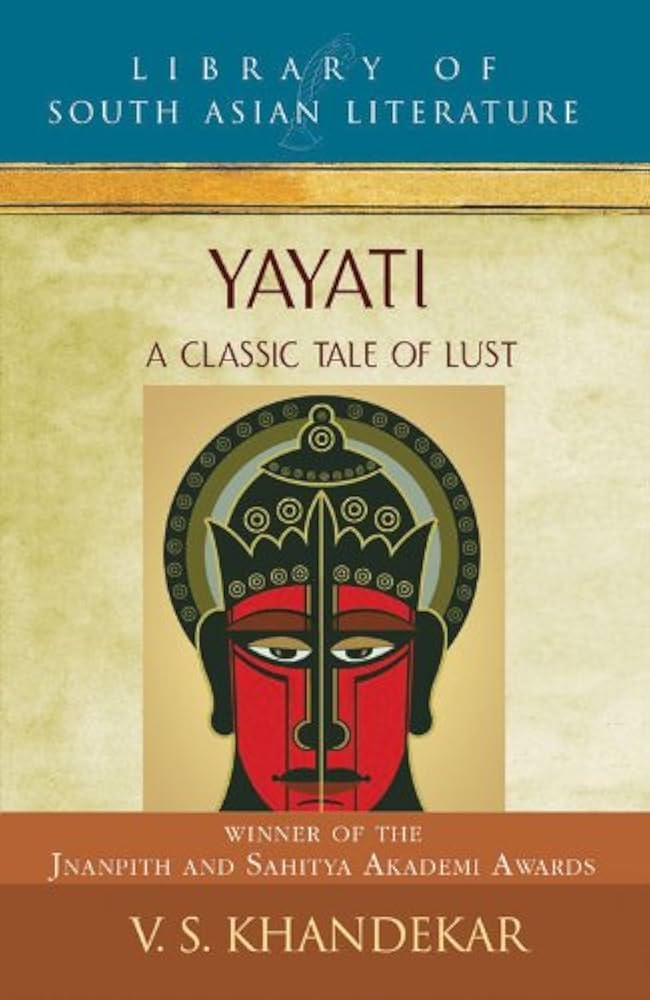
Yayati, a classic tale of lust by V.S. Khandekar, is a masterpiece. It has been honored with the prestigious Sahitya Akademi Award, the Jnanpith Award and numerous other recognitions. Last year, I had the privilege of reading the English translation of this work, done by Y.P. Kulkarni. As I read, I found myself regretting not being fluent in Marathi! Because, the original language carries nuances that may have been lost in translation. While I lack the capacity to offer a full review of such an iconic book, I felt compelled to write this article as a tribute to Yayati. Once again, I emphasize that this is not a formal review, but rather homage to a literary epic.
An Apt Title: Yayati — A Classic Tale of Lust
From the very beginning, Khandekar clarifies that his portrayal of the character Yayati differs subtly from the one in the Mahabharata. He takes creative liberties, reshaping characters like Yayati, Sharmistha, Devayani, and Kaccha to explore deeper themes. In this novel, Devayani is driven by a thirst for power while Kaccha assumes the role of a spiritual mentor. Sharmistha represents self-sacrifice; while Yayati’s obsession with pleasure knows no bounds. The title A Classical Tale of Lust becomes evident as you dive into the narrative, where the lust for power, love, and indulgence plays a central role.
In addition to the four primary characters, Khandekar introduces a host of supporting figures who enrich the story. These include Yati, the ascetic and Mukulika, a living embodiment of grace. There is Alaka, a golden-haired girl and Nahusha, the helpless king. Shukracharya is the wise and powerful teacher; while Madhav, plays the loyal friend. Each of these characters brings depth and texture to the narrative, and Khandekar’s attention to even the smallest events in their lives is remarkable.
The Churning of Emotions
As a reader, I find there are two kinds of writers. One masters language and craft literature with scholarly precision and the other excels at storytelling, making the narrative feel raw and alive. V.S. Khandekar combines both of these traits seamlessly. His writing is rooted in the simplicity of an ancient tale, yet his language brings a modern sensibility to it. The way he delves into the inner emotional turmoil of each character is nothing short of brilliant. It’s as though the novel itself is a process of emotional “churning”. The characters’ deepest desires, regrets, and hopes come to the surface in vivid, powerful ways.
A Golden Feather in Your Reading List
I would like to express my gratitude to Mr. Y.P. Kulkarni for his masterful translation of this timeless classic into English. His work has made it accessible to readers like me. When I truly love a book, I often recommend it to friends. But with Yayati, I feel compelled to say something more. Reading this book is not just about enjoying a good story—it’s about adding a golden feather to your reading list. Yayati is more than just a novel; it’s a literary experience that will stay with you long after you’ve turned the last page.