“Nobody remembers the girl born on Janmashtami, who sacrificed her life for Krishna. Another example of how a boy’s life was considered more precious than a girl’s.”
Now, unlike some of the absurd Hindu-phobic messages that circulate on social media, this one made me curious. It brings me to a genuine question, who is this girl? As far as I know, she is Yogmaya, the Goddess herself. But rather than going with the popular narratives, I decided to look at what the scriptures actually say about her. What happened to her after her encounter with Kamsa?
The Legend
The Bhagavata Puran gives us one of the most detailed accounts of Janmashtami. Ugrasen was the father of Kamsa and the king of Mathura. Devaki was Kamsa’s cousin and she was married to Vasudev. After the marriage of Devaki and Vasudev, a divine voice proclaimed, “The eighth son of Devaki will be the cause of Kamsa’s death.”
A terrified Kamsa imprisoned both Devaki and Vasudev. When Ugrasen opposed it, Kamsa usurped his throne and took control of the kingdom of Mathura. In due course, Devaki gave birth to six sons. One by one, they all met the cruel fate of being killed at the hands of Kamsa. When the time came for the seventh child, a miracle took place. With the help of Devi Yogmaya, the embryo was transferred from Devaki’s womb to Rohini’s womb. Rohini was Vasudev’s another wife and was living in Gokul. Thus Balaram was born. And because of this embryo transfer, he is also known as Sankarsana, meaning the one who was drawn away!
Birth of Yogmaya and Krishna
As per Bhagavata Puran, Vishnu asked Yogmaya to take birth in the house of Nanda and Yashoda. She was to be born at the very same time as Krishna, who would take birth as the eighth son of Devaki. At midnight, Vishnu appeared before Devaki and Vasudev in his divine form. He asked Vasudev to carry him to Gokul and exchange him with the new born girl of Yashoda.
A series of miracles took place after that. The gatekeepers of the prison slept like wooden logs while the iron gates open up automatically as if they were alive. Vasudev carried baby Krishna and walked towards Gokul. When he reached at the banks of Yamuna, the river became fordable and allowed Vasudev to cross. Vasudev finally reached Gokul and exchanged Krishna with the new born daughter of Yashoda.
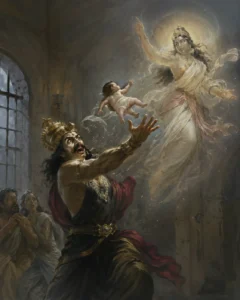
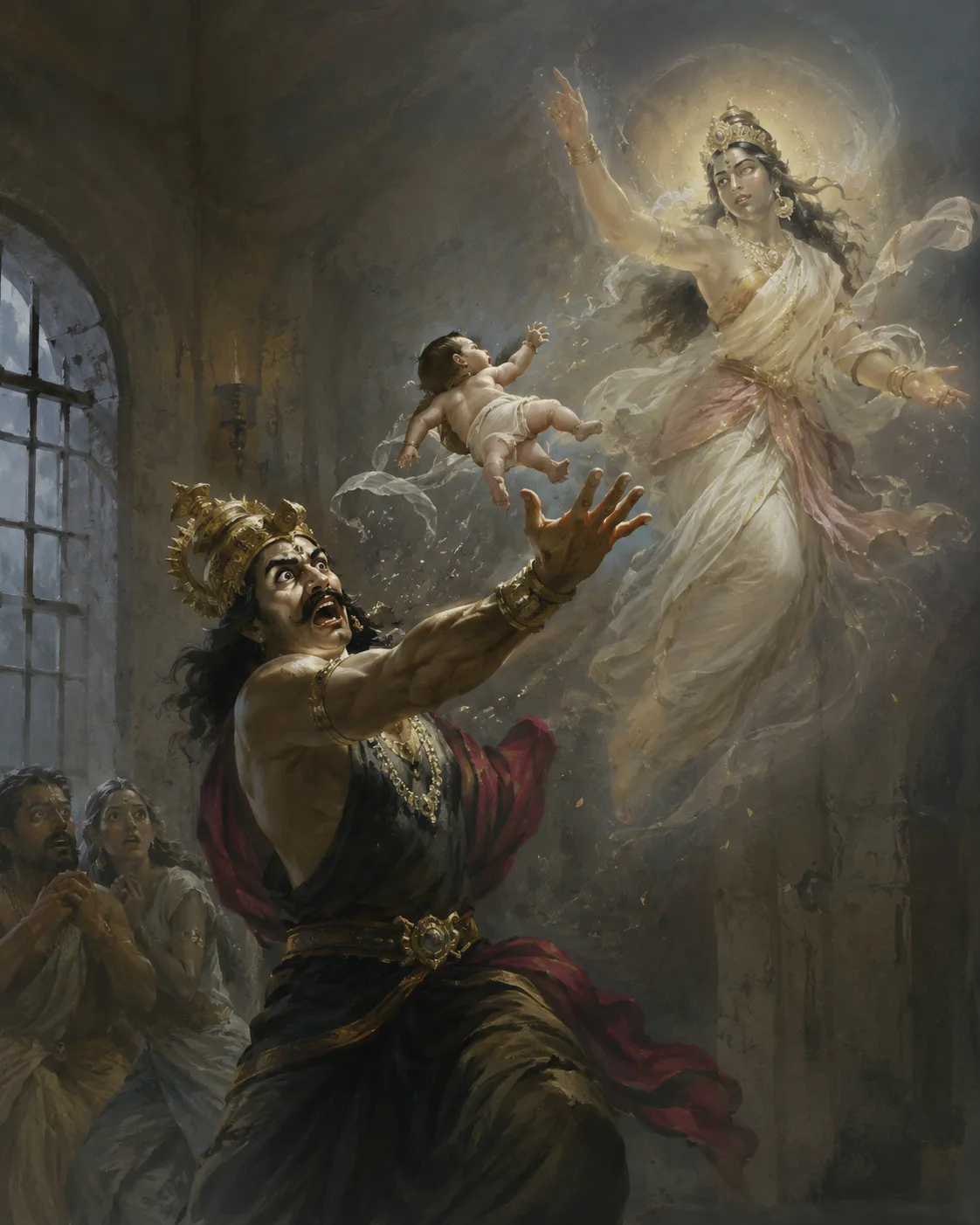
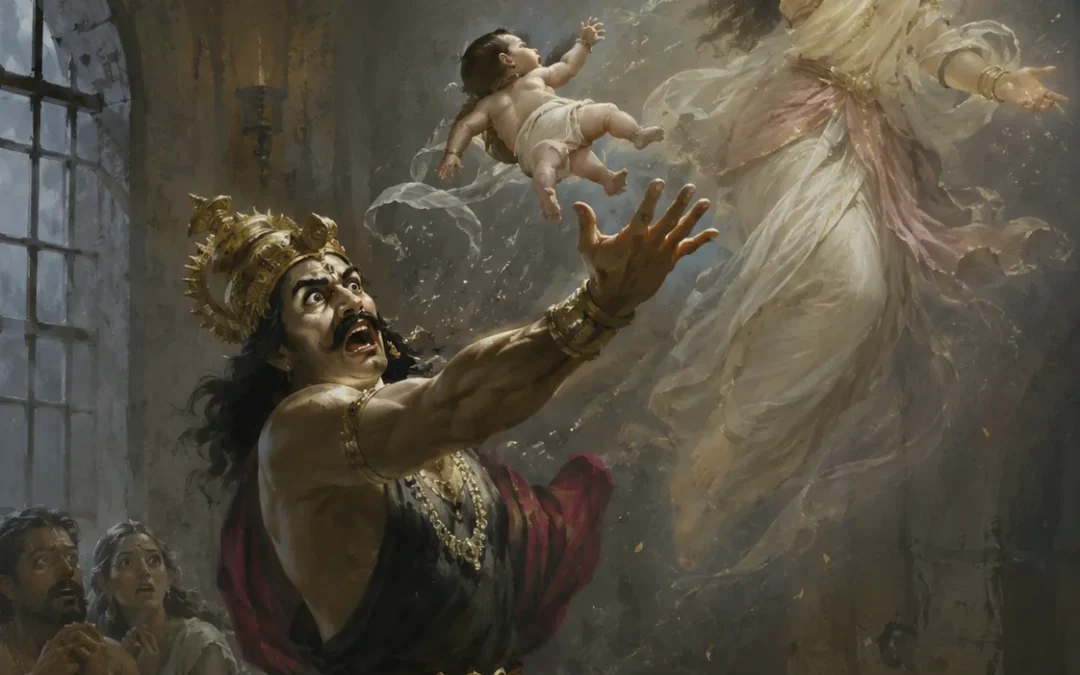
When Kamsa learnt of Devaki’s eighth child, he rushed to the prison. He took the baby girl from Devaki’s hand and tried to smash her against the stone, just as he had done with her six elder brothers. However, she slips from his hands and rises into the sky. There she transformed into the magnificent Goddess. And she informed Kamsa that, the one who is going to kill him, has been born somewhere else. Having delivered this warning, she disappeared.
What Happened to Yogmaya After She Escaped Kamsa
Did the scriptures really ignore Yogmaya’s story after this point? The Bhagavata Puran does not mention much about her, after she vanishes into the air. But does her story really end there? Not Really. The story continues in “Harivamsa Puran”, which is traditionally regarded as an appendix or supplement to the Mahabharat.
The Vishnu Parba of Harivamsa Puran does not treat the Kamsa episode as the end of Yogmaya story. It continued further. She is destined to make the Vindhya Mountains her abode. There she will be worshipped there as Maa Vindhyavasini. Devraj Indra will receive her as his sister. She will also be responsible for killing the demon Sumbha and Nisumbha.
Sumbha and Nisumbha
This is where the story gets absolutely fascinating. You ask the question from one scripture and the answer comes from another scripture. But here, the Sumbha and Nisumbha episode does not merely come from another scripture but it comes from a completely different theological tradition, the Sakta tradition. The detailed story of Sumbha-Nisumbha is found in the Devi Mahatmya.
According to the Devi Mahatmya, the demon brothers Sumbha and Nisumbha performed intense penance at Pushkara to please Brahma. Pleased with their devotion, Brahma appeared and granted them boon. They asked that they should not be killed by any man or Deva or Asura. After obtaining this boon, they conquered the three worlds. But they did not realize that their boon has a gap. Their boon protected them from male beings, but did not prevent a woman from killing them. Realizing that the Goddess was their only hope, the gods invoked her. It was then that the Goddess manifested as Ambika.
The Battle Between Ambika and Demons
Sumbha heard about the extra-ordinary beauty of Ambika and wanted to marry her. Goddess Ambika refused him saying, she will only marry one who could defeat her in a battle. The demon brothers did not take kindly to her refusal. They sent an army led by demon Dhumralochana to capture her. Devi Ambika killed her with remarkable ease. Sumbha then send the demon Chanda and Munda. Kali emerges from Ambika’s brow and kills Chanda and Munda
Following the deaths of Chanda and Munda, the demon Raktabija took charge of the war front. The demon possesses a super natural ability of multiplying himself. Every drop of his blood that fell on the ground, gives rise to another Raktabija. This makes him virtually impossible to defeat. Once again Goddess manifested Maa Kali. She began drinking his blood before it could touch the ground. Eventually, Raktabija died.
The Death of Sumbha and Nisumbha
Before Sumbha could face the Goddess, his brother Nisumbha attacked Goddess Chandika. She killed him with her spear. When Sumbha witnessed the destructions done by the Goddess, he accused her for not playing fair. He pointed out that, there are other Goddesses including Kali, has been fighting alongside her. The Goddess then made a powerful declaration: she alone exists; all the other goddesses are merely manifestations of her own power. With this, she absorbed all the other goddesses back into herself. A fierce battle took place between Devi Ambika and Demon Sumbha. The Goddess finally killed Sumbha with her weapon, bringing the battle to an end.
How it connects with Yogmaya or Vindhyavasini
This is perhaps the most interesting and lesser known part of the whole story. In the Devi Mahatmya, the name Vindhyavasini does not appear in context of killing Sumbha-Nisumbha. Here the Goddess is referred as Ambika, Chandika and Kausiki. So, does that mean, it is different from what is described in Harivamsa Puran. Not really!
The Devi Mahatmya clearly mentions that, in the 28th age of Vaivasvata Manavantara, the demon Sumbha and Nisumbha will be born again. And to destroy them, the Goddess will be born from the wombs of Yashoda, in the house of Nanda and will dwell in the Vindhya Mountains.
So, the girl who seems to have been sacrificed for Krishna’s life is not a victim at all. The text presents her as a future manifestation of the Goddess who will be born in Nanda’s house, dwell in the Vindhya Mountains and destroy the reborn Sumbha and Nisumbha.