In the Vedic tradition, a person’s Gotra or lineage holds a very important role in his life. Be it a thread ceremony or marriage or sraddha; the person need to mention his Gotra or lineage. So, how does one identify their Gotra? Well, there is no fixed formula for that. It is basically an oral tradition passed down from one generation to next generation. However, one thing is certain; Gotras are traditionally associated with the names of ancient sages. Today, in this article we will explore the stories of the famous Mandavya sage who is associated with the Mandavya Gotra.
Why Was Sage Mandavya Accused of Theft
The story of Sage Mandavya appears in Mahabharata as well as in the Brahmanda Purana and Markandeya Purana. So, here I am presenting the overall story rather than following a specific scripture. In a certain Kingdom, a group of thieves stole some properties of the King. The guards chased them and the thieves fled into the nearby forest. The forest was the home of Sage Mandavya. During that time, Sage Mandavya was engaged in deep meditation at his ashram. The thieves hid the stolen items in the ashram and ran for their life.
The Silence of The Sage and King’s Mistake
When the guards discovered the stolen items from his ashram, they assumed him to be the thief. The sage was observing a vow of silence, so he did not respond to their questions. They arrested him and took him to the King. The King interpreted the Sage’s silence as an acknowledgement of his guilt and ordered him to be punished. He was impaled on a spear. The sage controlled his body to remain alive, while enduring the pain caused by the spear.
The Night Trapped in Eternity
There lived a couple named Shilavati and Ugrashravas. (In some other versions, they are named as Sumati and Kaushika) Shilavati was known for her devotion and dedication towards her husband. When Ugrashravas was afflicted with leprosy, she cared for her husband with extreme devotion. One day, Ugrashravas expressed his desire to visit a prostitute. Without much hesitation, the devoted Shilavati, agreed to take her husband there. That night, she carried her husband one her shoulder and began walking towards the destination.
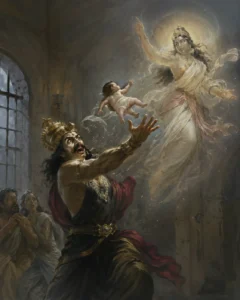
On their way, they passed through the place where Sage Mandavya had been impaled. Because of the poor moonlight, Ugrashravas’s feet accidentally touched the sage, causing him immense pain. The sage angrily cursed Ugrashravas to die at the next sunrise. Shilavati used the power of a devoted wife and ensured that the sun did not rise in the following morning. So, she literally trapped the night in an endless loop.
Devi Anusuya Saved The Day
That disrupted the cosmic cycle of day and night. All the Gods and Goddesses requested Devi Anusuya to find a solution to this problem. Devi Anusuya asked Shilavati to allow the sun to rise. She also promised the safety of her husband. When Shilavati finally agreed, the sun appeared on the eastern sky. As the sun appeared, the curse of sage Mandavya came true; Ugrashravas died. Thereafter, Devi Anusuya with her spiritual power restored the life of Ugrashravas, thus keeping her words to Shilavati.
Why Did Sage Mandavya Curse Dharmaraj
When the entire matter came to the King’s attention, he realized his grave mistake. He apologized to the sage and ordered that he be freed. However, the spear on which he had been impaled could not be completely removed from his body. As the tip of the spear remains in side his body, the sage later came to be known as Animandavya!
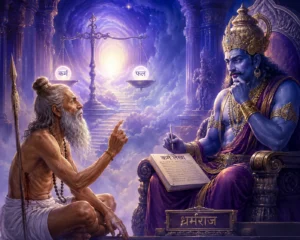
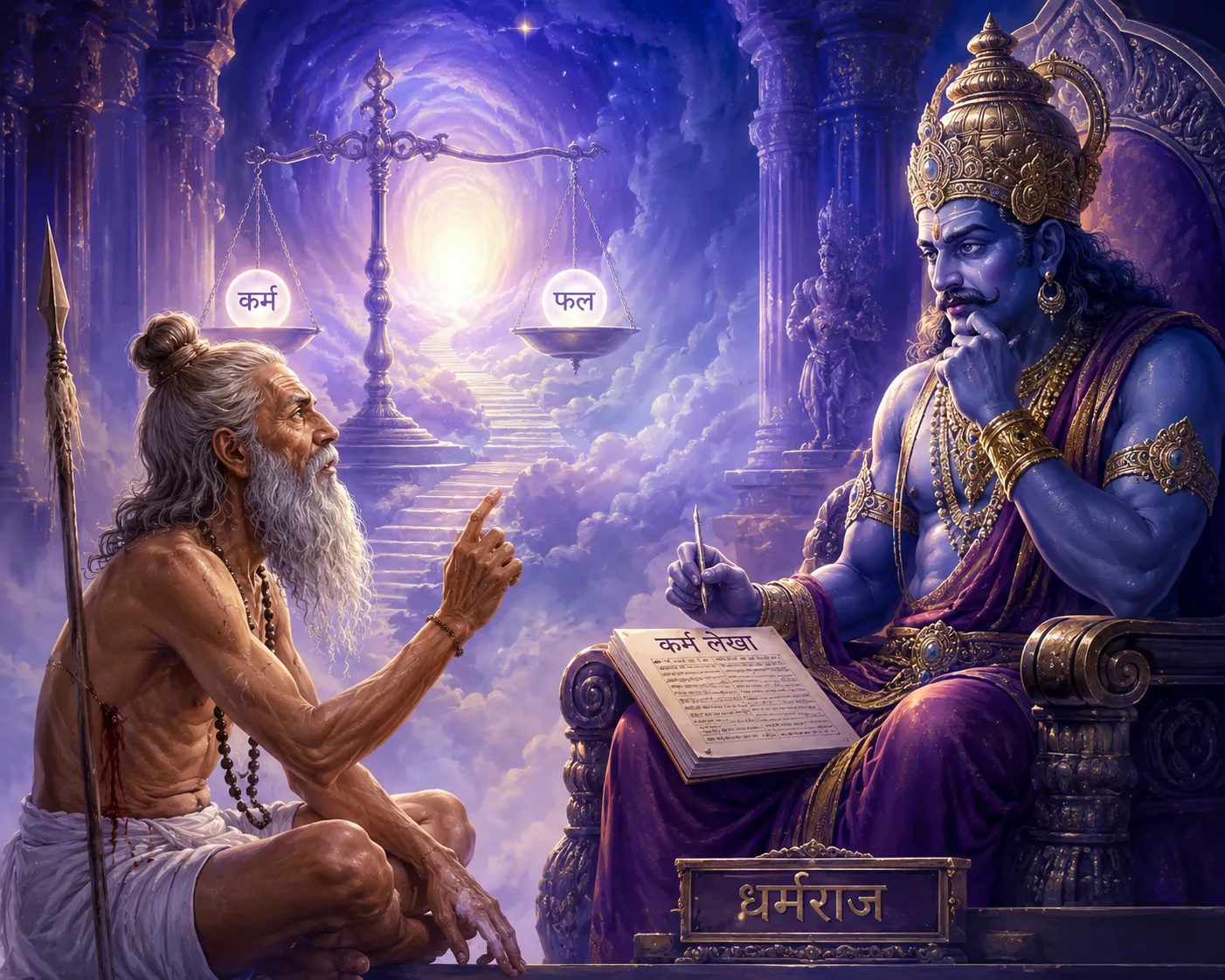
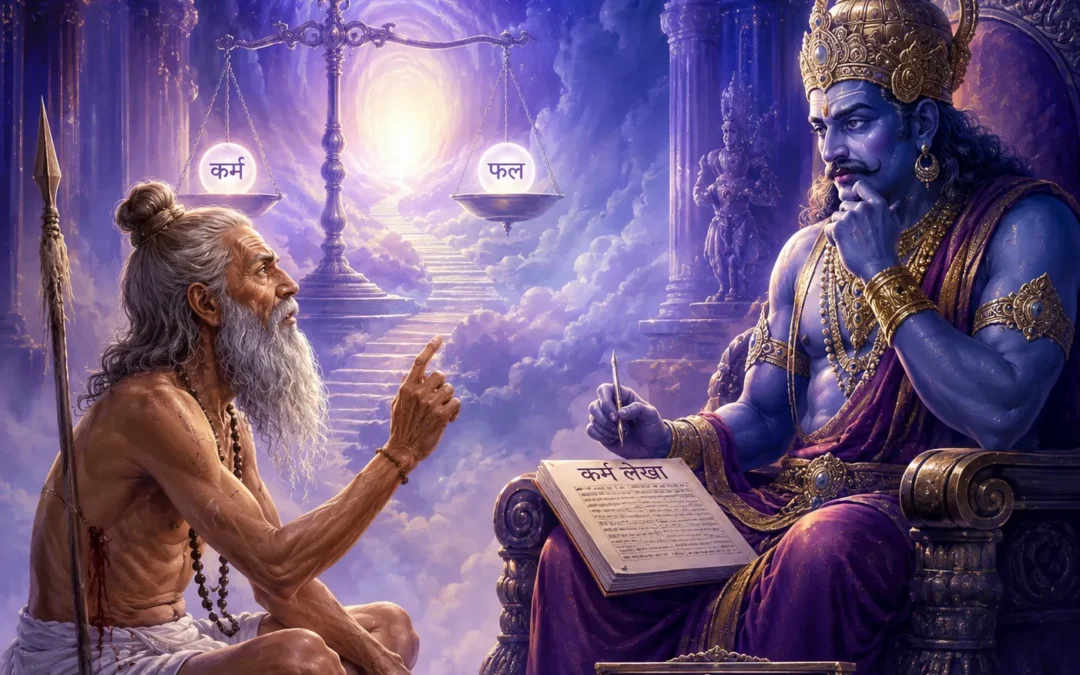
Sage Mandavya forgave the King but he wanted to know which karmic event of his life made him go through this suffering. So, he visited Dharmaraj Yama. He asked him, why he had been subjected to such immense pain. Yama informed him that, in his childhood he killed a few insects with a blade of grass. This is the result of that sin. Mandavya was deeply disturbed by this explanation. A profound debate followed between the sage and Yama regarding karma, justice, childhood actions and the maturity of the mind.
The Birth of Vidur
The sage reprimanded Yama for subjecting him to such severe suffering for an act committed during childhood. He argued that children should not be held responsible for actions committed before their minds have fully matured. He accused Yama of being unjust. And then he cursed him to born as a Shudra on the earth. That is how Vidur was born in this world through sage Vedvyasa and a Shudra woman.
The Deeper Meaning of Sage Mandavya’s Story
The stories above offer us several profound moral lessons. In many ways, that is what mythology is all about. It is not merely about telling stories, but it is about discovering the deeper wisdom hidden within it. Every story has something to teach us and it is up to us to look beyond the events and find the lesson within.
The story of Silavati reminds us about the extra-ordinary power of a devoted wife. We often speak about Savitri, the devoted wife who brings back the life of her husband Satyavan back from Yama through her devotion as well as wit. But this lesser known story also highlights the power of a devoted wife. For a mythology enthusiast, she is no lesser than the great Savitri.
No One Is Above Justice
The other thing that we have noticed here is the great sage Mandavya forgave the King for his mistake but cursed Yama at the same time. Why? The King was a human who is prone to mistake but being Dharmaraj, Yama could not afford to make mistakes. With greater power comes greater responsibility. The higher the position, the greater the expectation of wisdom, fairness and accountability!
More importantly, the story conveys a powerful principle: no one is above justice; not even the one who delivers it. Even Dharmaraj Yama had to face the consequences of his own actions. This is a recurring theme throughout Hindu mythology. In the Mahabharata, even Krishna is cursed by Gandhari. Indra, despite being the king of the Devas, has had to undergo severe consequences and penance for his actions, including the killing of a Brahmin. There are numerous such stories in which those who hold immense or even absolute power are still subject to the laws of Karma.
Perhaps that is one of the most profound ideas embedded in these stories: power does not place you above Dharma; it places a greater responsibility upon you to uphold it. If you are entrusted with delivering justice, you must also be prepared to stand before justice yourself. No one is above Dharma, and no one is beyond Karma.